
Ngā pūrongo o Kawau
Kawau project news and key safety information
Find project newsletters and access key safety factsheets for the Kawau Island pest eradication project.
Introduction
The success of this programme, initially and long term, depends on the support and involvement of Kawau Island’s community. Auckland Council is committed to working with you, keeping you up to date and listening to your feedback.
This is your page to keep up with all the important news on the Kawau Island pest eradication programme and some of the environmental outcomes we hope to celebrate in the future.
Email us to sign up for the project newsletter. See the operational updates section for the latest information.
Safety factsheets
Information for landowners and occupiers
The project team have prepared the Kawau Island eradication project factsheet for landowners and residents (PDF 1.85MB) that outlines important information for landowners, occupiers and visitors to the island. It contains key information that is important to read.
Keeping dogs safe
Dogs are the most at-risk pets during a 1080-based pest control operation. Always supervise your dog and keep them on a leash in affected areas. Do not let them roam or eat animal remains. Consider using a muzzle. If you suspect your dog has eaten 1080 poison, make the dog vomit immediately if possible and call your vet straight away.
For those on the island, this is likely the Warkworth Vets – 09 425 8244
Alternatively, contact the Auckland Council call centre (24 hours) – 301 0101 for locations of emergency emetic medication.
Check out the dog protection factsheet (PDF 1.02MB) for further information.
Safety tips
During the operation and six months afterward:
• do not touch bait that is dyed green
• watch children at all times
• keep dogs away from poison baits and animal remains, as 1080 they are toxic to animals
• read and follow all safety signs.
National Poisons Centre
If you think someone has been poisoned, call the New Zealand National Poisons Centre immediately - 0800 764 766
Contact details
Email us at kawauislandproject@aucklandcouncil.govt.nz or phone (09) 301 0101.
Latest newsletter - February 2026
Kawau Island multi-species eradication project - Working towards a pest free Kawau Island
Spotlight on Kawau Island’s Kiwi: new survey sheds light on a little-known population
Summer has been a mixed bag for most of us. We’ve had periods of extended sunshine as well as some messy weather thanks to sub-tropical conditions. We know that this changeable weather can bring challenges for residents and visitors to the island, including some of our lesser-known residents, who are usually most active at night.
Last year, the team announced the completion of a North Island Brown Kiwi survey, providing the clearest picture yet of the kiwi living on Kawau Island (Te Kawau Tūmaro-o-Toi), confirming both the uniqueness of this population and the challenges it faces.
Undertaken between January and March 2025, the mark-recapture dog survey (standard method used in ecology to estimate population size, survival rates and population trends where it is impractical to count every individual) is the first to directly assess the health, structure and genetics of kiwi on the island. It builds on more than three decades of earlier listening surveys, acoustic recorders and even a thermal camera study, all of which confirmed kiwi were present on Kawau, but left many questions unanswered.
Auckland Council’s Project Manager Lisa Tolich says the survey gives essential baseline information that simply wasn’t available before. “Following on from the recent forest ecosystem monitoring work, this kiwi survey is a key ecological assessment. It helps us understand how habitat condition and pest pressures are affecting kiwi, and it will guide future habitat restoration and management priorities”.
Genetic sampling has also revealed Kawau kiwi have very low genetic diversity, with many individuals closely related. This reflects the population’s origins, believed to trace back to a small number of birds introduced from the Hokianga in the 1860s, with possible additional introductions decades later.
While some unique genetic traits remain, long-term isolation raises concerns about inbreeding and resilience. Save the Kiwi, who carried out the survey on behalf of Auckland Council, says the findings highlight both urgency and opportunity.
“Kawau Island’s kiwi are clearly special, but they can’t thrive in isolation forever,” says Tineke Joustra, Operations Manager for Save the Kiwi.
This research allows us to consider habitat improvement alongside carefully managed translocations to strengthen the population while also protecting its unique genetics.
The survey was funded by Auckland Council’s Natural Environment Targeted Rate and carried out under Save the Kiwi’s Wildlife Authority. Regular monitoring and integrated genetic planning are now recommended, positioning Kawau to play a meaningful role in the wider recovery of kiwi across Aotearoa. To read the full report visit the Save the Kiwi publication Population Survey for North Island Brown Kiwi (Apteryx mantelli) on Kawau Island - December 2025 - Final report (PDF 3.5MB).
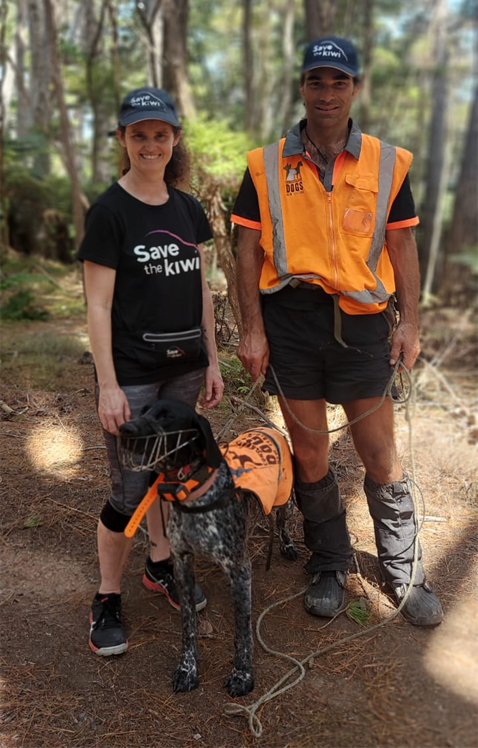
Emma Craig from Save the Kiwi with kiwi detection dog Kimihia and handler Tom Donovan.
Findings from the Challenger Point treatment trial
The Technical Advisory Group recently met to review the findings of the Challenger Point treatment trial, which finished in December. The small-scale treatment trial was designed to evaluate foliage baiting methods for reducing wallaby populations. It was also to test our assumptions on alternative food availability, wallaby behaviour, bait palatability (like introducing cut foliage with 1080 gel as a lure) and presentation.
Key findings from this trial include:
- The trial demonstrated that foliage baiting could be conducted safely.
- Foliage baiting proved an effective approach with all species of wallaby filmed consuming foliage without inhibition.
- The trial reduced the number of wallabies within the trial area by approx. 85 per cent - 70 individuals (parma, dama and swamp wallabies) were detected in drone surveys prior to the trial. Just 11 were detected with the same amount of effort after the trial.
- Zero interactions with non-target species were observed via the monitoring network.
As a result, the Technical Advisory Group recommends adding 1080-gel–treated cut foliage, alongside cereal bait for possums, as a control tool on Kawau Island.
Next steps
Following the successful treatment trial at Challenger Point Peninsula, we are aiming to deliver a ground-based application of 1080 cereal bait and cut-foliage treated with 1080 gel in the southern sector (excluding residential areas and block one).
- The toxin application will support the ongoing hunting effort to remove wallabies and possums where numbers are high, which has been revealed by regular camera and drone monitoring in the southern blocks.
- We plan to start in the second week of March 2026, weather permitting. The window is timed to avoid school and public holidays.
- The treatment area is on private property and gates to the property will be locked. Please refer to figure 2 below.
- Baits will be placed a minimum of 20 metres from private tracks and roads.
- Two non-toxic pre-feeds of cereal bait have been completed to familiarise possums and wallabies with cereal as a food source.
- Warning signage will be in place at wharves, main entry points to the treatment area and at treated foliage sites.
- Neighbouring properties will be notified ahead of toxic bait application and once foliage bait has been removed. Cereal bait will degrade naturally in the environment.
- Public Health conditions including exclusion zones for block one and setbacks from residential areas will apply, along with monitoring of ground-based domestic water supplies within or downstream of treatment areas.
- Carcasses will be removed where practical, however a caution period of several months will follow while carcasses naturally breakdown. Visit the project website for operational updates. See the Kawau Island eradication project factsheet for landowners and residents (PDF 1.85MB) for more information.
When targeted 1080 toxin operations are underway, it is important for all residents and visitors to the island to:
- Observe all warning signage.
- Stay out of designated treatment areas where bait is laid.
- Supervise children at all times.
- Toxins can be deadly. 1080 gel is lethal in small quantities if swallowed.
- In the case of suspected poisoning – dial 111 for an ambulance / rescue chopper immediately and call Poison’s Centre 0800 POISON (0800 764 766) for advice while awaiting emergency services.
Dog safety reminder during and post-operation. See the dog protection factsheet (PDF 1.02MB) for more information.
- Keep dogs supervised at all times-ideally on leash.
- Do not allow roaming, especially into bush areas or treatment blocks.
- Visitors are advised not to bring dogs into the southern sector during the caution period.
- If walking a dog, keep it on track, well fed and hydrated.
- Do not let dogs scavenge carcasses under any circumstances. If you suspect poisoning: induce vomiting immediately and contact Warkworth Vets: 09 425 8244.
- Muzzles and emetic medication are available free of charge and on request from Warkworth Vets, 23 Hudson Road, Warkworth.
To keep up to date on operational progress and important safety information visit Working towards a pest free Kawau Island. Please observe all signage and instructions relating to operational activity.
If you need to get in touch with the project team email kawauislandproject@aucklandcouncil.govt.nz
Visit the project website for Kawau project news and key safety information.
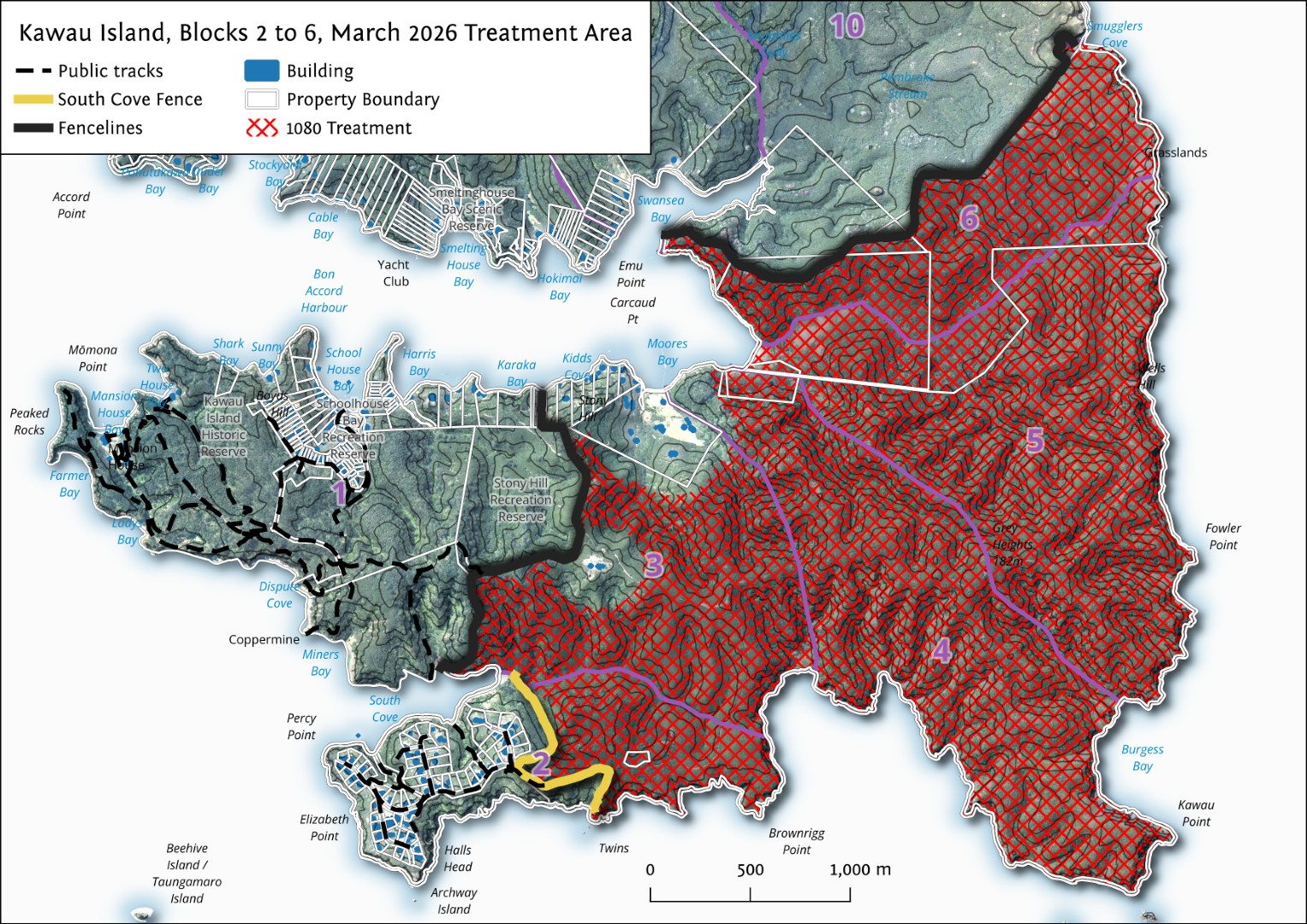
Figure 2. Map of planned ground based 1080 toxin treatment area on private land. Download the map (PDF - 2.51MB)
Keep up the good work this summer
Keeping Kawau free from the threat of invasive pests starts in your own backyard:
✅ Leave a dedicated set of tools and boots at the bach so you’re not bringing unwanted weeds and their seeds from the mainland.
✅ If you can’t, give everything a good scrub before you travel.
✅ Check out the Pest ID search to locate information about pest plants and animals in Auckland.
✅ When buying plants, choose plants from a producer participating in Plant Pass.
✅ Give all gear a good shake out to make sure pesky animal pests aren’t stowing away.
🌱 Small steps in your garden make a big difference for native plants, birds, and insects across the Hauraki Gulf.
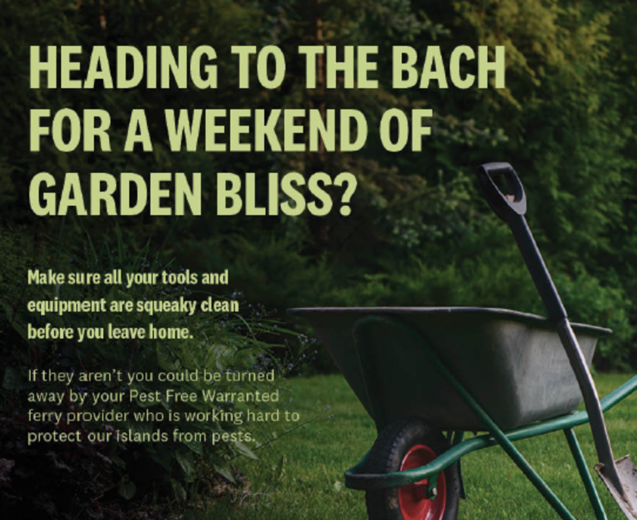
Figure 3. Biosecurity campaign signage.
Previous newsletters
- 16 December 2025 - Pest Free Kawau December newsletter - operation update, pause of operations during summer and more (PDF 5MB)
- 17 October 2025 - Pest Free Kawau October newsletter - operation update and progress updates (PDF 1MB)
- 22 August 2025 - Pest Free Kawau August newsletter - operation update, kiwi survey, kiwi avoidance training and more (PDF 1MB)
- 11 July 2025 - Pest Free Kawau July newsletter - Important operations update, fun Kiwi footage and more (PDF 1.27MB)
- 13 June 2025 - Operation update, Community safety, June Community Forum meeting and more (PDF 871KB)
- 13 May 2025 - Operational update and project factsheet (PDF 946KB)
- 22 April 2025 - Project update, Argentine Ant work and success, and April Community Forum meeting (PDF 1MB)
- 13 February 2025 - February Community Forum meeting and NZ Nature Fund campaign (PDF 277KB)
- 31 January 2025 - Supplier announcement and project updates (PDF 1.2MB)
- 17 December 2024 - December Community Forum Meeting And Kiwi On Kawau (PDF 577KB)
- 25 October 2024 - Pest Free Kawau October update- New project video and webpages, dotterel season, and ecosystem monitoring (PDF 1.1MB)
- 13 September 2024 - Project update, Argentine Ants incursion and getting ready for Summer (PDF 1.2MB)
- 19 July 2024 - Project update, funding and property permissions and guides (PDF 705KB)
- 21 May 2024 - Community Forum Update And Stoat Detection Surveys (PDF 415KB)
- 27 March 2024 - Community Forum Reminder And Highlighting Kawau Community Conservation (PDF 705KB)
- 1 March 2024 - Adapting Our Approach In Response To Community Feedback (PDF 875KB)